Old-Air Mars and Old-Wet Venus
Science and Science-Fiction,
Then and Now
background & definitions:
Old-Air Mars
Old-Wet Venus
Old-Spacetime
Home there's no returning
The future isn't what it used to be
It's a commonplace — however unconscious or taken for granted — that fantasy is ageless, it lives in an "eternal present" which does not age however human affairs march on; while science fiction reflects current speculation about the future, perhaps a step or two or even a hundred, ahead of actual current science. Thus fantasy written long ago may still feel fresh; while science-fiction stories, even the best of them, when created enter a Red Queen's race, pinned in time by their dependence on their origin. Science advances, science fiction does not. Sooner or later specific science fiction therefore must fall out of step as real life (life experienced) moves into the future. Science fiction as we recognize it today perhaps becomes obsolete, then quaint, then scarcely readable antiques for literary historians only.
Nevertheless, "Here I stand, I can do no other".
I've coined several terms to aid in our understanding and discussion; here are my definitions:
Old-Wet Venus is our Sunward neighbor world, which before modern long-distance analysis, was presumed (without evidence) to have a human-breathable humid atmosphere, swamps, shallow seas, grassland and forests, a usually-warm or -hot climate. In science-fiction stories set on this Old-Wet style Venus, humans can live without extraordinary difficulties, usually survive without exotic equipment. Early science fiction set on Venus, or referring to it, generally used this background in explicit detail or implicit background. The perpetual cloud cover encouraged free rein for the imagination.
Old-Air Mars is our Outward neighbor world, which before modern long-distance analysis, was presumed (with minimal or misleading evidence) to have a human-breathable dry atmosphere, canals or even rivers, wide deserts, grassland, perhaps a seasonal hot / cold climate. In stories set on this Old-Air style Mars, humans can live without extraordinary difficulties, usually survive without exotic equipment. Early science fiction set on Mars, or referring to it, generally used this background in explicit detail or implicit background.
Old-Spacetime is our Solar, Interstellar, Galactic, Universal, or even Temporal habitat, which before modern long-distance analysis and blue-sky theorizing, was presumed (with minimal or misleading evidence) to be reasonably traveled faster-than-light, lived-in, and so on as above. In stories set in this Old-Spacetime, pretty much anything goes, in one story or another. Early science fiction set beyond Earth's atmosphere, or referring to it, generally used these backgrounds in explicit detail or implicit background.
Home there's no returning; or, New wine in old wineskins is our ongoing revisited — histrorical — view of the above approaches and habitats. A surprising number, although seemingly dated, are rated "classics", still in print a generation or two beyond their first publication. In retroactive stories in these settings, humans can live without extraordinary difficulties, often survive without exotic equipment, and so on as above. Retroactive fiction set on Mars, Venus, and onward, or dependent on the older views, generally employ these themes in explicit detail or implicit background. The best are re-imagined ideational heirlooms, thoughtfully filtered and freshly fermented. It is extremely difficult to do this well.
© 2024, 2026 Robert Wilfred Franson
I've been impelled to make a couple of tweaks to the above definitions after pondering James Gifford's scholarly discussion of the Future History stories and the Future History chart variants in his Robert A. Heinlein: A Reader's Companion. — RWF
RG advised on this.
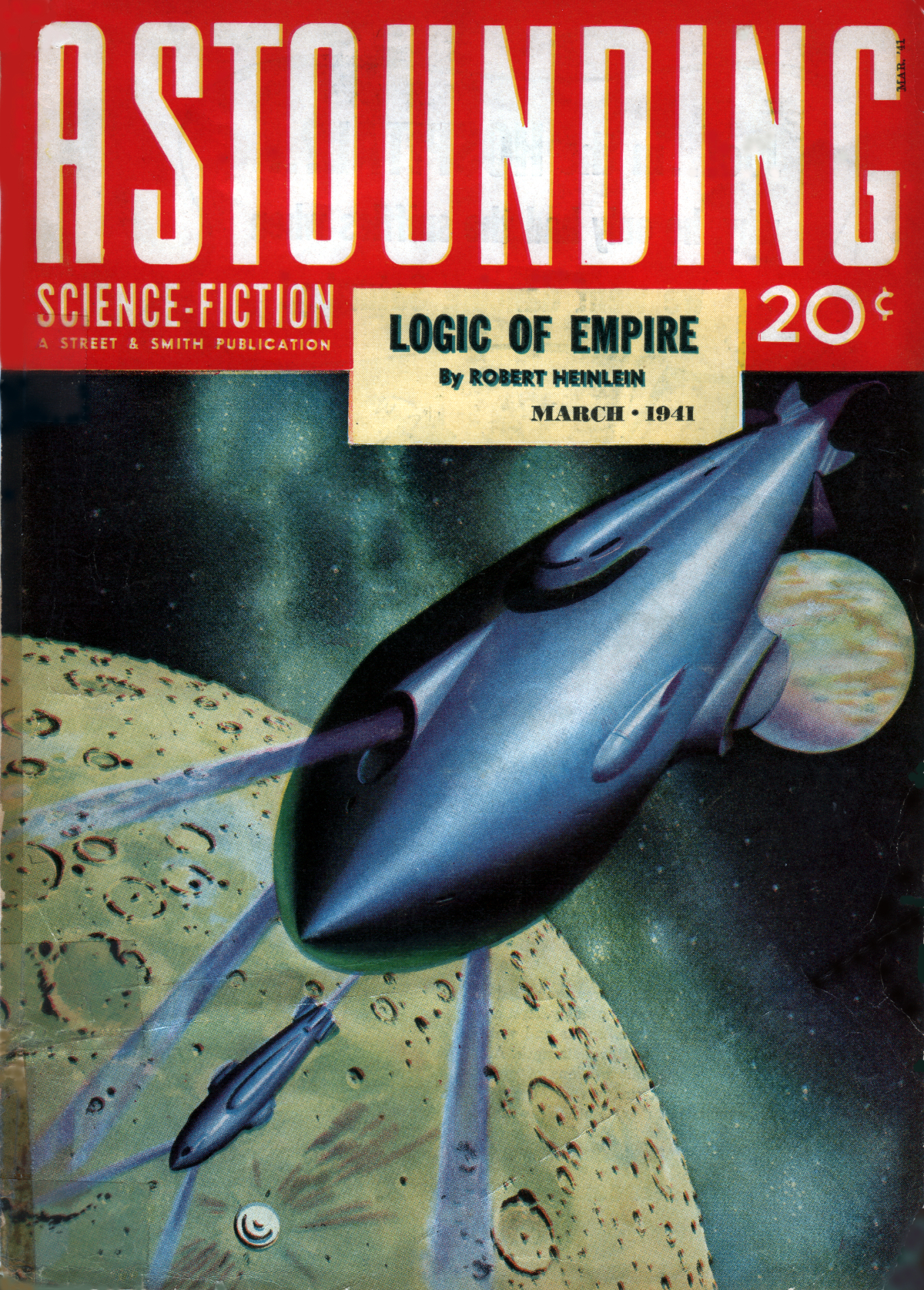
magazine cover, bottom:
Astounding Science-Fiction
March 1941
by Hubert Rogers
by Robert A. Heinlein
right-hand column lists a spectrum of exemplars;
your spacetime(s) may differ
Citizen of the Galaxy
by Robert A. Heinlein
"The Doors of His Face,
the Lamps of His Mouth"
by Roger Zelazny
Four-Day Planet
by H. Beam Piper
Junkyard Planet
(The Cosmic Computer)
("Graveyard of Dreams")
by H. Beam Piper
Talents, Incorporated
by Murray Leinster
Wasp
by Eric Frank Russell
The Witches of Karres
by James H. Schmitz
| Troynovant, or Renewing Troy: | New | Contents | |||
| recurrent inspiration | Recent Updates | |||
|
www.Troynovant.com |
||||
|
Reviews |
||||
| Personae | Strata | Topography |
|
|||