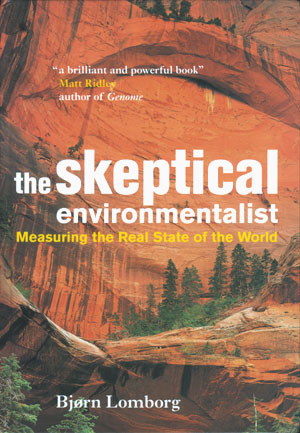
The Skeptical Environmentalist
Measuring the Real State of the World
by Bjorn Lomborg
Verdens sande tilstand
Centrum: Aarhus, 1998
322 pages
Revised and updated edition:
Cambridge University Press: 2001
Presumptions shape expectations
When science fiction writers envision possible futures for the world, their cultures' serious expectations about the real or probable future unavoidably shape those visions. Consider, for example, the many novels of the 1950s and 1960s set in worlds recovering from a nuclear war, such as Andre Norton's Star Man's Son, Edgar Pangborn's Davy, or John Wyndham's Re-Birth.
In more recent decades, one of the most prevalent such visions, and the focus of as many fears as nuclear war, has been environmentalism and its predictions of global ecological catastrophe. The Skeptical Environmentalist: Measuring the Real State of the World offers an invaluable assessment of how well founded those fears really are.
 Its author, Bjorn Lomborg, a professor of statistics at a Danish university, describes himself as "an old left-wing Greenpeace environmentalist". In 1997, reading an interview with Julian Simon in Wired Magazine ("The Doomslayer" by Ed Regis), he saw Simon's claim that environmentalist fears are not supported even by the actual governmental statistics that environmentalists cite to support their views.
Lomborg organized a seminar to assess Simon's claim by careful review of the actual statistics — it was exactly the sort of project that's best suited to teach research and analysis skills to students. In his own words, "we expected to show that most of Simon's talk was simple, American right-wing propaganda". Much to his and his students' surprise, the great majority of Simon's claims were supported by the evidence.
The Skeptical Environmentalist documents that conclusion. Most of its content is a straightforward review of factual evidence on a wide range of topics: resource exhaustion, pollution, human health and prosperity, and future threats of global warming and mass extinctions.
The evidence on most of these points shows that conditions grew steadily better during the late 20th Century, the very period when environmentalists often claimed that they were getting steadily worse. For example, the proportion of people starving in Third World countries has decreased over recent decades; in fact, despite massive Third World population growth, the actual number of people starving has fallen from 920 million in 1971 to 792 million in 1997. Certainly this isn't ideal, but it doesn't represent catastrophic failure of the food production system. And similar lessons can be drawn for most other issues.
Interspersed with these masses of data are occasional theoretical analyses, often turning on economic principles. There are historical perspectives, such as a discussion of Stanley Jevons' The Coal Question, originally published in 1865, which predicted that English industry would soon end when the coal mines ran out. (Every futurist ought to read Jevons — not because of what he got right, but for the cautionary effect of seeing what he got wrong. For example, Jevons mentioned solar energy but dismissed petroleum on the ground that, since it was not used as fuel at the time, it never would be an important fuel.)
And Lomborg gives pointed criticisms of leading environmentalists, such as Lester Brown of Worldwatch Institute, and Paul Ehrlich. While sharing environmentalist goals, Lomborg does not believe that either science or the environment is served by biased interpretations of the evidence, and still less by wild claims that derive from no factual evidence at all — and he cites many examples of both.
Libertarianism need not be hostile to the environment; private property rights and the framework of common law offer the best way to protect the environment, and free markets in fact embody the same diversity and decentralization that ecologists praise in the nonhuman world. Libertarians do have many disagreements with environmentalism as a movement. Often these come down to appeals to conflicting theoretical and philosophical perspectives. But Lomborg presents the factual evidence to show that the libertarian perspective is a better model of the real world. And that same evidence will be well suited to the needs of science fiction writers, libertarian or otherwise, who want to envision more plausible and realistic futures as settings for their stories.
© 2003 William H. Stoddard
First published in Prometheus, Spring/Summer 2003
Libertarian Futurist Society
R. W. Franson's
Statistics and Environmentalists
The Case of Bjorn Lomborg
More by William H. Stoddard
American scientists speak out
against the Kyoto Protocol
Global Warming Petition Project
| Troynovant, or Renewing Troy: | New | Contents | |||
| recurrent inspiration | Recent Updates | |||
|
www.Troynovant.com |
||||
|
Reviews |
||||
| Strata | Regions | Personae |
|
|||