A Tale of Two Clocks
by James H. Schmitz
Torquil / Dodd, Mead
New York, 1962: 206 pages
sometimes reprinted as Legacy
collected in —
Trigger & Friends (as Legacy)
(significantly abridged by editor;
see Publication Notes below)
Enter Trigger Argee, armed & thoughtful
It was the time of sunrise in Ceyce, the White City, placidly beautiful capital of Maccadon, the University World of the Hub.
In the Colonial School's sprawling five-mile complex of buildings and tropical parks, the second student shift was headed for breakfast, while a large part of the fourth shift moved at a more leisurely rate toward their bunks. The school's organized activities were not much affected by the hour, but the big exercise quadrangle was almost deserted for once. Behind the railing of the firing range a young woman stood by herself, gun in hand, waiting for the automatic range monitor to select a new string of targets for release.
She was around twenty-four, slim and trim in the school's comfortable hiking outfit. Tan shirt and knee-length shorts, knee stockings, soft-soled shoes. Her sun hat hung on the railing, and the dawn wind whipped strands of shoulder-length, modishly white-silver hair along her cheeks. She held a small, beautifully worked handgun loosely beside her — the twin-barrelled sporting Denton which gunwise citizens of the Hub rated as a weapon for the precisionist and expert only. In institutions like the Colonial School it wasn't often seen.
This is Trigger Argee. She is one of James H. Schmitz's engaging heroines — in a body of work filled with interesting heroines, from the exotic Zone Agents of Agent of Vega to the teenage mentalist Telzey Amberdon and the mentalist witch-girls of The Witches of Karres. Trigger has an advantage over Telzey and the young witches in being of sufficient maturity for romance, and in fact herein she has a couple of romantic entanglements: with Brule Inger, her boyfriend from the earlier story "Harvest Time"; and despite her best intentions, with Heslet Quillan, the tough and quick fellow we also see in "Lion Loose".
A Tale of Two Clocks is an excellent novel. So why does it give an impression of being not quite complete between its own covers?
There's an old joke among writers and editors about how to achieve a sense found in New Yorker short stories — not of detachment exactly, the stories may be intense and focused — but of semi-plots somehow unmoored from their surroundings. The trick is that after you write your story, throw away the first three pages and the last three pages before submitting it to the magazine.
James Schmitz writes in a concise and allusive manner. Even his best science fiction sometimes suffers from a problem similar to that of the putative New Yorker writers: that important story elements, if not merely alluded to, are scattered among stories not obviously related, except in being part of his future-galactic Federation of the Hub series. Before the inclusive Baen Books collections, these stories were not published together systematically.
The scattering is not a problem in the Federation of the Hub series as a whole if you manage to read all of them in a reasonably short period. But the way individual novels are packaged, we naturally expect a novel to tell its whole story. The Demon Breed does not include its predecessor novelet "Trouble Tide", but that short novel stands alone perfectly well. On the other hand, when Schmitz extended his 1949 novelet "The Witches of Karres" into his 1966 masterpiece The Witches of Karres, that novel begins with the novelet and moves forward seamlessly. So those two are fine.
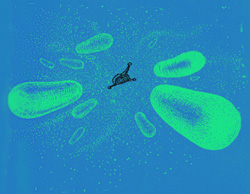 But A Tale of Two Clocks is a fine and complete novel in all aspects save one: its central puzzle is just a little too mysterious. This puzzle is the nature of the plasmoids, biological automata of all sizes from biologic nuts-and-bolts up through breadbox-size to vehicle-size. But there is a cluster of questions more directly related to the Old Galactics, an alien race vanished some 30,000 years back. What were the Old Galactics like? Why did they create the plasmoids? Why can't Hub scientists duplicate or even control the plasmoids? Why do groups of plasmoids tend to stop functioning abruptly, and not resume activity?
It helps if you've previously read "Harvest Time", in which the plasmoids are discovered, harvesting the aerial plankton in the atmosphere of the planet Manon. Trigger Argee and Precolonial Commissioner Holati Tate continue their roles from "Harvest Time". The xenobiology expert Professor Mantelish is way too abstracted to keep security in mind. At the other extreme, Pilch, the subtle Psychology Service woman from "Sour Note on Palayata" reappears here. There is a excellent collection of villains, villainesses, and their henchmen.
Following A Tale of Two Clocks, the stories "The Pork Chop Tree" and "Compulsion" give concrete details about the Old Galactics that flesh out hints and tidbits given in the novel.
I'll give just this key hint: the Old Galactics move on a much slower time scale than humanity; they live by a vastly slower metabolic clock. As with Eric Frank Russell's classic "The Waitabits", understanding and communication are difficult when clock-speeds are different, and may be insuperable when clock-speeds are widely divergent.
So if this novel has a weakness, it is in the allusiveness applied to the plasmoids and the Old Galactics. My advice is to take any background that's not fully understood as given, read the related stories before or after, and meanwhile go along for the ride. For it has a fast plot, fine characters, humor and romance, and lots of action.
Schmitz assigns the date for "Harvest Time" and A Tale of Two Clocks as 3498 A.D., about two years preceding the cluster of stories at his Hub benchmark year of 3500 A.D. This book was Schmitz's first major foray into the Federation of the Hub, and it almost was the last:
In the novel A Tale of Two Clocks, written in 1959, story requirements developed considerable further detail about the Hub, particularly in regard to various official and semiofficial organizations. In fact, I had established and recorded a good deal more about it than I realized at the time. But I felt no inclination then to do more with the Hub. After finishing the novel I became involved in work which had nothing to do with science fiction, and it was a year and a half before I got back into that area of writing. [...] and started looking around for something new.
The Federation of the Hub occurred as a possible plot background. But my immediate feeling was that the novel already had presented whatever was of interest about that civilization and that I should set up something else.
James H. Schmitz
The Federation of the Hub:
Self-Maintaining Science Fiction Universe
Science Fiction Review (Franson / Sandin)
Number 41, November 1965
Fortunately Schmitz realized that his already extensive work on the Hub could spin off in all sorts of interesting directions. The work in and for A Tale of Two Clocks thus laid the foundation for the wonderful explosion of Hub science fiction that followed in the 1960s, including the Telzey Amberdon series.
For a different angle on the Hub stories, another quotation from A Tale of Two Clocks is included for discussion in Schmitz's ComWeb here — along with a bit about Heslet Quillan, introduced in "Lion Loose", which you should also read before this novel.
Heslet Quillan is Trigger Argee's ally in the subtle confrontations and the sometimes furious action growing out of the struggle to understand and control the plasmoids. Trigger strongly denies any personal interest in Quillan, a man well ahead of her in life experiences — of which she declares she strongly disapproves; and she suspects she would disapprove of more of his adventures if she knew what they were.
We may presume, as Trigger does, that Quillan's erotic experience is ahead of her own. Yet because of this, Quillan perceives a potential in Trigger that she hasn't seen herself. Without her being fully aware of it, her biological clock is beginning to come into phase with Quillan's.
An example: without a single lascivious word, Schmitz provides a scene of a woman trying on a fancy gown, a process he makes both humorous and erotic — never an easy combination. While they're both on a luxury starship passage, Heslet Quillan sends Trigger a daring Beldon creation in several small packages:
Out of the third flowed something which was, at all events, extraordinarily beautiful material of some kind. Velvety green ... shimmeringly alive. Its touch was a caress. Its perfume was like soft whispers. Lifting one end with great care between thumb and finger, Trigger let it unfold itself toward the floor.
Tilting her head to the side, she studied the shimmering featherweight cat's cradle of jewel-green ribbons that hung there.
Wear it?
What was it?
Via her starship cabin's ComWeb, Trigger calls a fellow passenger for feminine advice. Informed that her gift is a high-fashion gown, she dubiously wriggles into it.
She stepped in front of the mirror. Her eyes widened. "Brother!" she breathed.
That Beldon did go with a woman like stripes went with a tiger! After one look, you couldn't quite understand why nature hadn't arranged for it first. But just as obviously there wasn't nearly enough Beldon around at the moment.
Back to her ComWeb to call the starship's fashionable Beldon shop ...
Here we have the thorough femininity of Trigger Argee, both her modesty and her not-entirely-admitted desire to dress-to-impress Heslet Quillan. And we feel strongly the powerful human biological clockwork — in the form of Trigger it looks very nice indeed.
So the tale really is in the clocks. A fun, subtle, romantic, allusively erotic novel, full of science-fictional ideas and adventure — very enjoyable.
© 2002 Robert Wilfred Franson
Astounding September 1958
illustration (color added) for "Harvest Time"
by Frank Kelly Freas
Livelong at Troynovant
longevity & immortality
The Federation of the Hub
Self-Maintaining Science Fiction Universe
by James H. Schmitz
Publication Notes
A Tale of Two Clocks has been printed as a separate book several times, sometimes generically and unfortunately retitled Legacy; and a surprisingly abridged version (96% of original) is included (as Legacy), with its overture "Harvest Time", half-prequel "Lion Loose", and other Hub stories, in the collection Trigger & Friends.
I regret that the Baen collection doesn't contain an accurate and complete text of this important novel by Schmitz, a most subtle and sophisticated stylist. If you possess the novel as it appears in a standalone book, read or re-read that by preference. Baen Books provides an online or downloadable original version of A Tale of Two Clocks (as Legacy) & the other four most sadly "edited" stories in their collection: James H. Schmitz originals at Baen (itself not a clean text, at least in my copy). Minor changes for political correctness you are expected to put up with.
Two sequels with Trigger Argee that reveal more about the Old Galactics, "The Pork Chop Tree" and "Compulsion" also are included (the former embedded in the latter as a prologue) with other Hub stories in the collection TnT: Telzey & Trigger.
Cover paintings for A Tale of Two Clocks span a wide artistic range: the novel's first cover may charitably be termed unusual; the uncredited cover for the 1965 Belmont edition fairly conveys one erotic scene; but Bob Adragna's cover for the 1979 Ace edition (retitled as Legacy) showing both Trigger in action and hovering plasmoids is the best.
| Troynovant, or Renewing Troy: | New | Contents | |||
| recurrent inspiration | Recent Updates | |||
|
www.Troynovant.com |
||||
|
Reviews |
||||
| Strata | Regions | Personae |
|
|||